Before you start
What this method is trying to achieve
Airy focaccia starts with a wet dough that can trap gas without being beaten dry with extra flour. Give the dough short rests and folds to build strength, wait for visible expansion during both rises, then dimple gently so you keep as much gas as possible before the hot bake.
Success looks like
Know the target before you cook
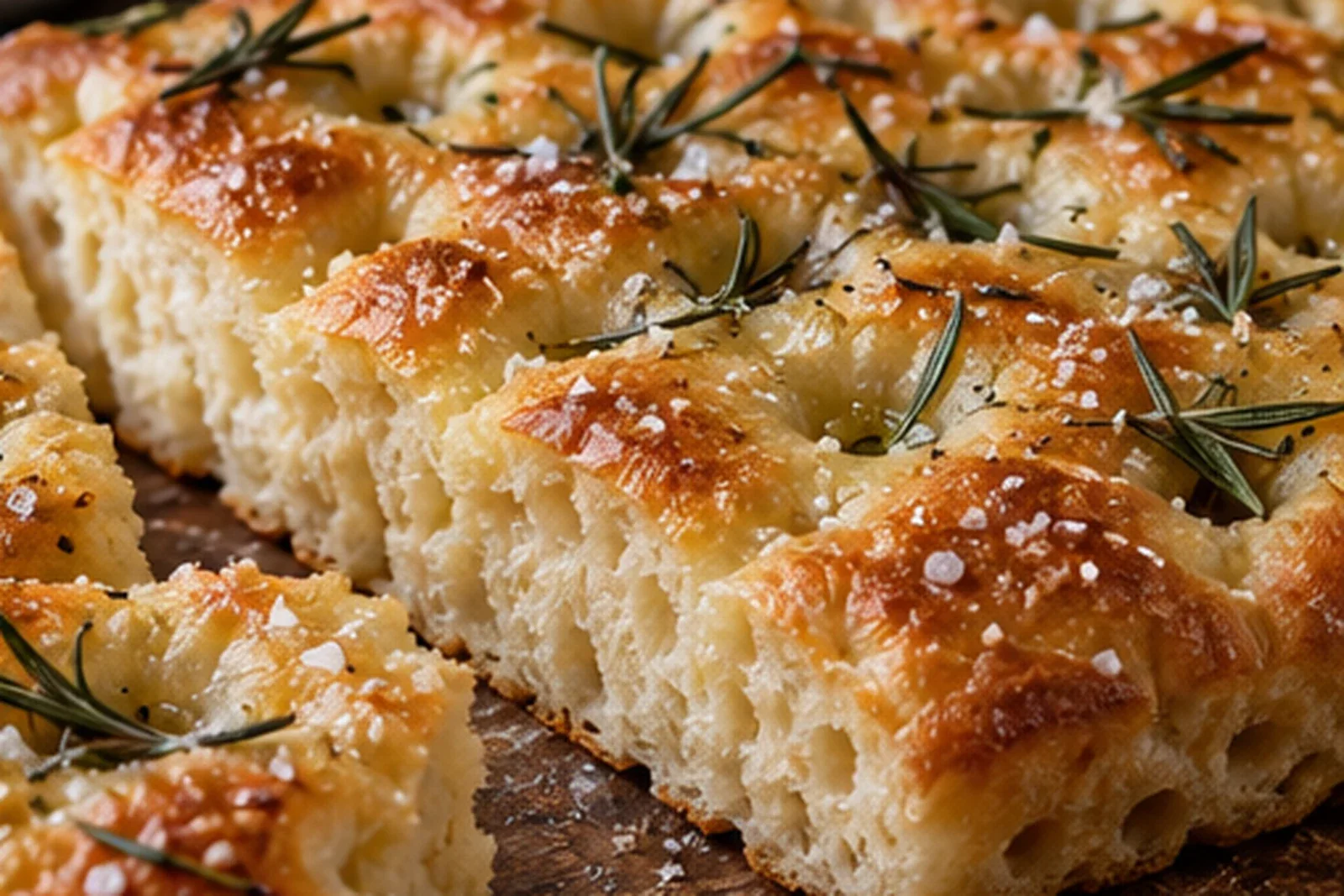
The focaccia should be tall and light with large irregular bubbles, a bronzed top and crisp edges rather than a tight, bread-like slab.
Ingredients
What you need
Dough
- 360 g all-purpose flour
- 9 g table salt
- 5 g granulated sugar
- 3 g instant yeast
- 284 g water, warm, about 90°F to 110°F / 32°C to 43°C
- 18 g extra-virgin olive oil
Pan and topping
- 26 g extra-virgin olive oil, divided
Topping
- 1 tsp flaky sea salt
- 1 tbsp fresh rosemary leaves, roughly chopped — Optional but matches the classic herb profile.
Method
Cook by the cues, not just the clock
Mix and rest
Whisk together flour, salt, sugar and yeast. Add the warm water and 18 g olive oil, then stir until completely homogeneous with no dry pockets. Cover and rest 15 minutes.
Four folds
With a wet hand, lift and fold sections of dough toward the center all the way around the bowl. Rest 15 minutes and repeat three more times for four folds total.
Bulk rise
Cover and let the dough rise around 70°F to 75°F / 21°C to 24°C for about 1 hour, until nearly doubled, very puffy and possibly bubbly on top.
Pan and final proof
Oil a 9-inch square metal pan with half the topping oil, transfer the dough gently and turn it to coat. Cover and let rise 1 to 1 1/2 hours until marshmallowy, jiggly and close to the pan edges.
Dimple and bake
Heat the oven to 475°F / 246°C. Oil your fingers, press decisive dimples to the bottom without flattening the dough, drizzle with the remaining oil, rosemary and flaky salt, then bake 15 to 18 minutes until deeply golden. Remove from the pan and return briefly to the turned-off oven rack for 5 to 7 minutes if the sides need extra crispness.
Critical checkpoints
Stop here and check
After folds: did the dough gain strength?
The dough is still soft and wet but stretches as one stronger mass instead of flowing like batter.If it remains weak, complete the planned folds and rests before adding flour.
Before dimpling: is the dough marshmallowy?
The dough is jiggly, very puffy and nearly fills the pan.If it is still compact, extend the final rise; dense focaccia often begins with insufficient fermentation.
After baking: are the edges crisp and crumb light?
The top is bronzed, crevices are golden and the sides release with crisp color.If the crumb is tight despite full color, use the linked focaccia-dense diagnosis to separate hydration, proofing and dough-strength causes.
If yours looks different
Route the failure before changing the recipe
After cooking
Storage, reheating & substitutions
Storage
Focaccia is best the day it is baked. Keep leftovers loosely wrapped at room temperature and reheat before serving.
Reheating
Warm in a hot oven until the surface and sides become crisp again. Avoid prolonged microwaving if crispness matters.
Substitutions
A 10-inch cast-iron skillet or larger metal pan can be used, though thickness changes with pan size. Dried rosemary or other restrained herbs can replace fresh rosemary.
Evidence
Sources & methodology
Technical claims and method decisions are tied to sources. Recipe-specific advice is not presented as a universal food-science law.
- Big and Bubbly Focaccia RecipeKing Arthur Baking
King Arthur uses 360 g flour with 284 g water, develops the wet dough through four folds, proofs until nearly doubled and later marshmallowy and jiggly, then dimples and bakes at 475°F until browned.
publisherPassage verified - FocacciaKing Arthur Baking
King Arthur’s classic focaccia method confirms a doubled first rise, a second rise before dimpling, and a hot bake followed by olive oil and herbs.
publisherPassage verified