Before you start
What this method is trying to achieve
Starter is easier to manage when you track what it does after each feeding instead of chasing a fixed calendar. Begin with equal weights of whole-grain flour and water, then keep a small portion and feed equal weights of all-purpose flour and water. Temperature changes the timeline, so judge readiness by expansion, bubbles and aroma.
Success looks like
Know the target before you cook
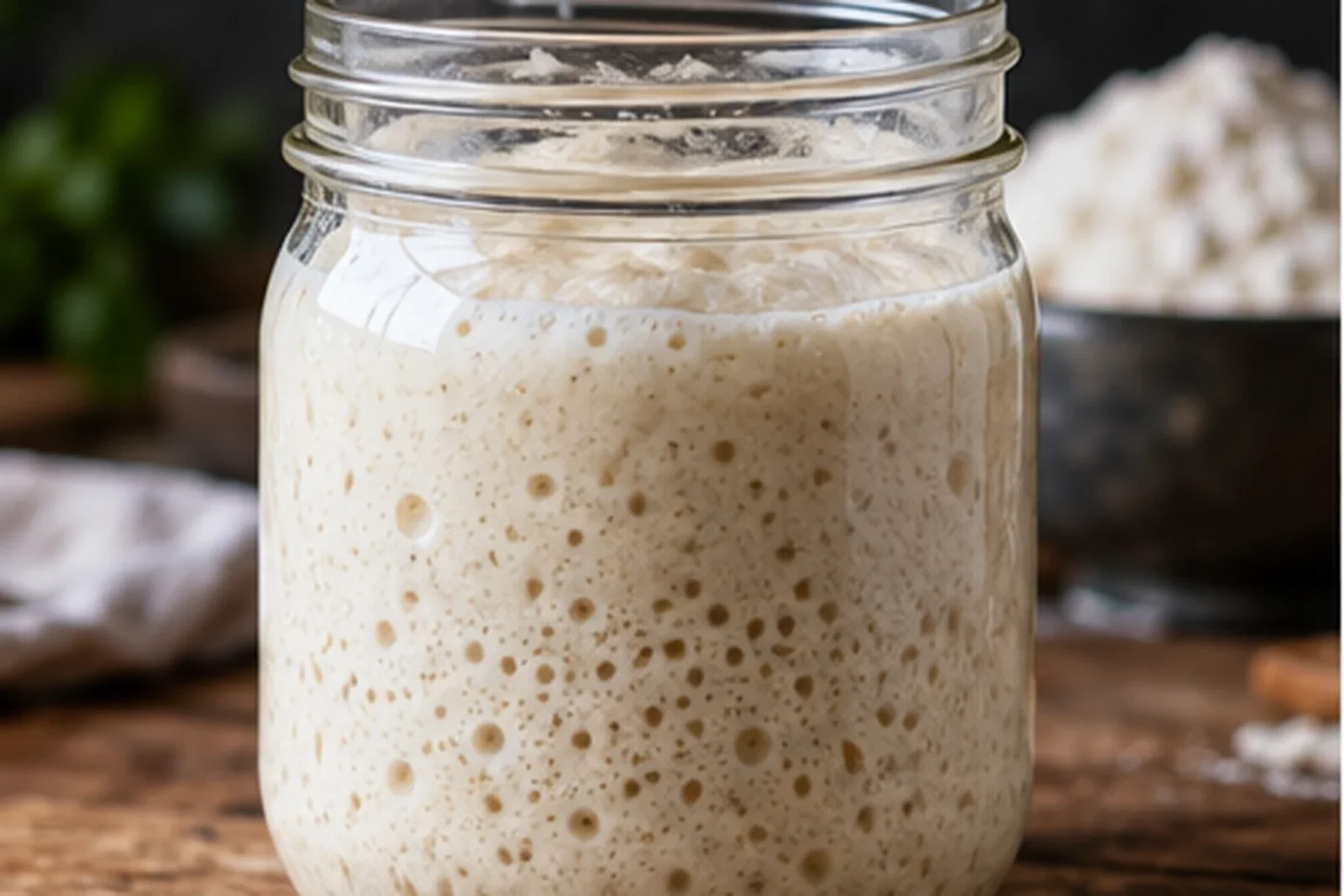
A healthy mature starter should be bubbly throughout, smell pleasantly tangy and reliably double in volume after feeding; that repeatable rise is the signal that it is ready to leaven bread.
Ingredients
What you need
Day 1
- 50 g whole wheat flour — Pumpernickel flour can be used instead.
- 50 g water, cool to lukewarm — Use cooler water in a warm kitchen and lukewarm water in a cool kitchen.
Each feeding
- 50 g starter from the previous feeding, well stirred — Retain this amount and discard or repurpose the remainder.
- 50 g all-purpose flour
- 50 g water, cool to lukewarm
Method
Cook by the cues, not just the clock
Day 1 — mix
Combine 50 g whole wheat flour with 50 g water in a clean non-reactive container. Stir until no dry flour remains, cover loosely and leave at warm room temperature for 24 hours.
Day 2 — first feed
Stir the culture, keep 50 g, and mix it with 50 g water and 50 g all-purpose flour. Cover loosely and leave it at room temperature for another 24 hours.
Day 3 — increase frequency
Keep 50 g starter and feed with 50 g water and 50 g flour. From this point, repeat the same feeding about every 12 hours.
Days 4 and 5 — build strength
Continue twice-daily feedings, keeping the ratio consistent. Keep the starter around 70°F to 78°F when practical and give it more days if it remains slow.
Confirm readiness
After a feeding, mark the level and watch the rise. Once the starter repeatedly doubles in about 6 to 8 hours and is bubbly throughout, use the ripe portion for baking and keep a small amount for maintenance.
Critical checkpoints
Stop here and check
Early activity: is anything happening yet?
During the first day the mixture may show no activity or only a few bubbles.Continue the scheduled feed rather than changing the formula simply because day one looks quiet.
Environment: is the starter too cool?
A starter kept below roughly 68°F often rises much more slowly than one kept in the low-to-mid 70s.Move it to a gently warmer location and keep the feeding ratio unchanged before diagnosing a weak culture.
Ready to bake: does it double predictably?
After feeding, the starter rises to about twice its marked volume within roughly 6 to 8 hours and is bubbly throughout.If it still barely rises, follow the linked sourdough-starter diagnosis before using it as the only leavening in bread.
If yours looks different
Route the failure before changing the recipe
After cooking
Storage, reheating & substitutions
Storage
Keep a frequently used starter at room temperature with regular feedings. For less frequent baking, refrigerate a mature starter and give it several room-temperature feedings before baking again.
Reheating
Not applicable. Bring refrigerated starter back to room-temperature feeding conditions before judging activity.
Substitutions
Whole wheat or pumpernickel flour can be used for the first mix. Once established, all-purpose flour works well for routine feedings.
Evidence
Sources & methodology
Technical claims and method decisions are tied to sources. Recipe-specific advice is not presented as a universal food-science law.
- Feeding and Maintaining Your Sourdough StarterKing Arthur Baking
King Arthur describes regular room-temperature feedings and says a starter that doubles or triples within about 6 to 8 hours is ready to bake with.
publisherPassage verified - Sourdough Starter RecipeKing Arthur Baking
King Arthur starts with 50 g whole-grain flour and 50 g water, transitions to 50 g starter plus 50 g each flour and water, and considers the starter ready when it is bubbly and reliably doubles in about 6 to 8 hours.
publisherPassage verified