Before you start
What this method is trying to achieve
Cheesecake is a custard-style bake, so the goal is not to whip in air or bake until the middle feels completely firm. Use room-temperature ingredients, mix the eggs only until incorporated, moderate the edge heat with a water bath, and let the cake cool gradually before its long refrigerator set.
Success looks like
Know the target before you cook
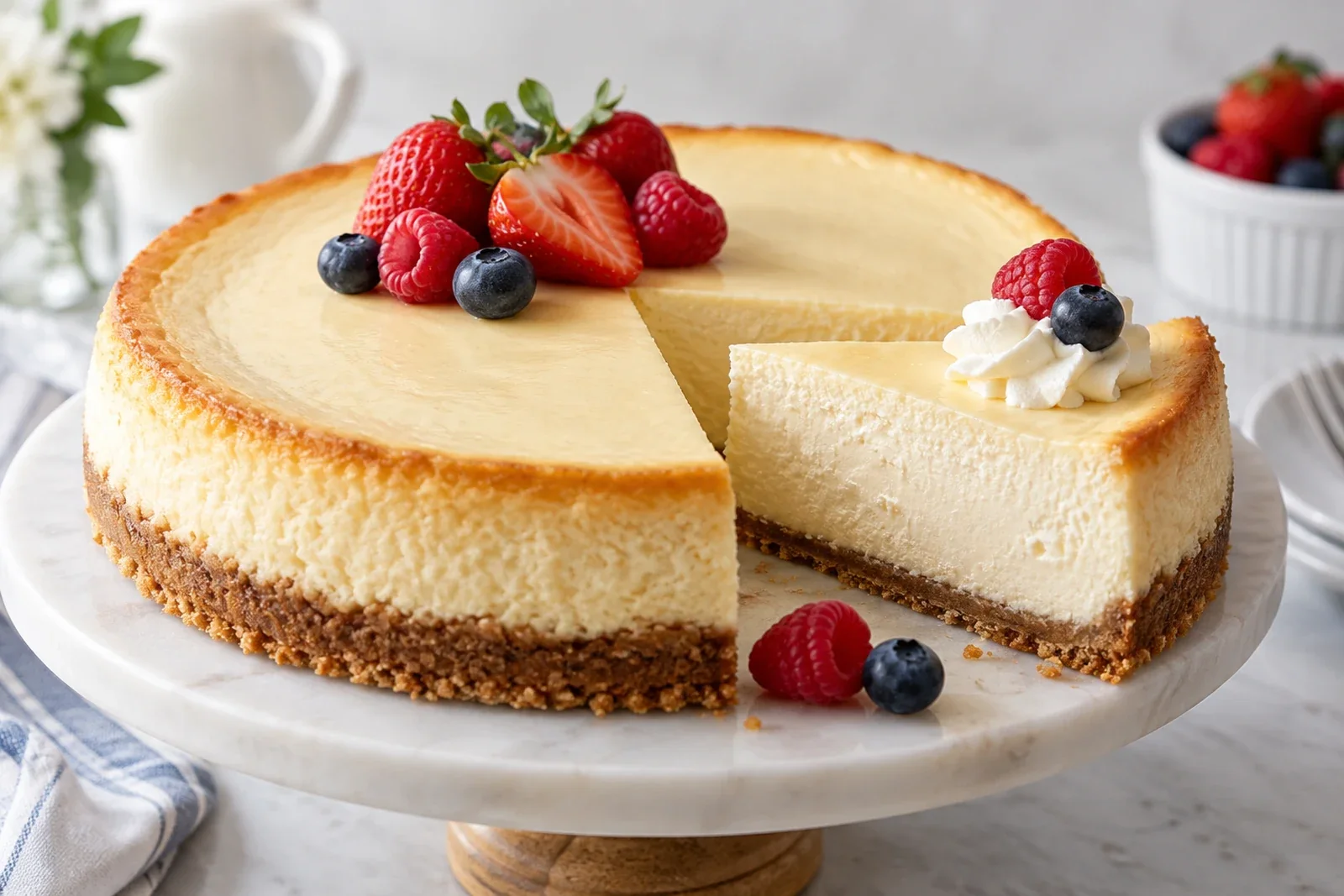
The chilled cheesecake should have a smooth creamy filling, a firm graham cracker base and a top that stays mostly level rather than puffing dramatically and splitting.
Ingredients
What you need
Crust
- 170 g graham cracker crumbs — About 1 1/2 cups finely ground crumbs.
- 85 g unsalted butter, melted — Reserve a little for greasing if needed.
- 25 g granulated sugar
- 1 pinch fine salt
Filling
- 907 g full-fat cream cheese, room temperature — Four 8-ounce blocks.
- 350 g granulated sugar — Enough for a classic sweet cheesecake without changing the tested structure dramatically.
- 240 g sour cream, room temperature
- 2 tsp vanilla extract
- 4 large eggs, room temperature
Method
Cook by the cues, not just the clock
Bake the crust
Heat the oven to 165°C / 325°F. Mix the crumbs, melted butter, sugar and salt, press evenly into the base of a 9-inch springform pan and bake until lightly golden, about 15 minutes. Cool while you make the filling.
Protect the pan
Wrap the outside base and sides of the springform pan securely with wide heavy-duty foil, then set the pan inside a large roasting pan.
Mix gently
Beat the room-temperature cream cheese and sugar only until smooth. Mix in the sour cream and vanilla, then add the eggs one at a time on low speed or by hand, stopping as soon as each disappears into the batter.
Bake in water bath
Pour the filling over the cooled crust. Add hot water to the roasting pan until it reaches roughly halfway up the outside of the wrapped springform pan. Bake until the outer area is set but the center still has a controlled wobble, about 75 to 85 minutes.
Cool gradually
Turn the oven off and leave the cheesecake inside for 1 hour. Move it to a rack, loosen the edge carefully with a thin knife if needed, and cool to room temperature.
Chill
Cover and refrigerate at least 8 hours before unmolding and slicing. Use a warm clean knife for neat portions.
Critical checkpoints
Stop here and check
After mixing: is the batter smooth but not foamy?
The filling is cohesive with few visible air bubbles and has not increased dramatically in volume.Stop mixing once the eggs are incorporated instead of whipping for extra smoothness.
Near the end: set edge, gently moving center?
The outer ring is set while the central area still moves slightly as one mass when the pan is nudged.Begin gradual cooling rather than waiting for the center to look fully dry.
During cooling: did the top split?
A visible crack forms during baking or as the cheesecake cools.Use CookClue's cheesecake-cracked diagnosis to distinguish overbaking, excess air, uneven heating and rapid cooling.
If yours looks different
Route the failure before changing the recipe
After cooking
Storage, reheating & substitutions
Storage
Keep covered in the refrigerator and serve chilled or after a short temper at room temperature. Refrigerate leftovers promptly.
Reheating
Do not reheat cheesecake. Let a chilled slice stand briefly at room temperature if you prefer a softer texture.
Substitutions
Use full-fat block cream cheese for the most predictable structure. Changing to spreadable tub cream cheese or low-fat products changes water content and may alter the set.
Evidence
Sources & methodology
Technical claims and method decisions are tied to sources. Recipe-specific advice is not presented as a universal food-science law.
- The Best CheesecakeFood Network Kitchen
Food Network Kitchen's classic cheesecake uses room-temperature cream cheese, sour cream and eggs, mixes the eggs only until combined, bakes the springform pan in a hot-water bath and cools the cake gradually after baking.
publisherPassage verified - Easy CheesecakeKing Arthur Baking
King Arthur's current cheesecake method emphasizes softened room-temperature cream cheese, avoiding excess incorporated air and stopping while the center is not yet completely firm.
publisherPassage verified